

Electrical problems in homes commonly show up as tripped breakers, flickering lights, warm or sparking outlets, and buzzing sounds. Most trace back to overloaded circuits, outdated wiring or a connection that has come loose over time.
Some of these are a quick fix. Others are an early warning sign of something developing behind the wall, which is why knowing the difference matters more than memorizing a symptom list.
This guide explains how to assess the severity of electrical problems in homes, what commonly causes them, and where the line sits between a homeowner check and a visit from a provider of residential electrical services in Orlando. For a broader symptom overview, read our guide to common electrical issues in Orlando homes.
Quick answer for electrical problems in homes
The most common electrical problems in homes are frequently tripped breakers, flickering or dimming lights, and outlets or switches that feel warm or show discoloration.
These symptoms usually come from one of three root causes: an overloaded circuit, a loose electrical connection, or wiring that has aged beyond what it was designed to handle.
Buzzing sounds, sparking, smoke or any burning smell should be treated as an active safety issue rather than a maintenance item to schedule for later. Basic preventive checks can be organized using our electrical maintenance checklist for Orlando properties.
How to determine whether an electrical problem is serious
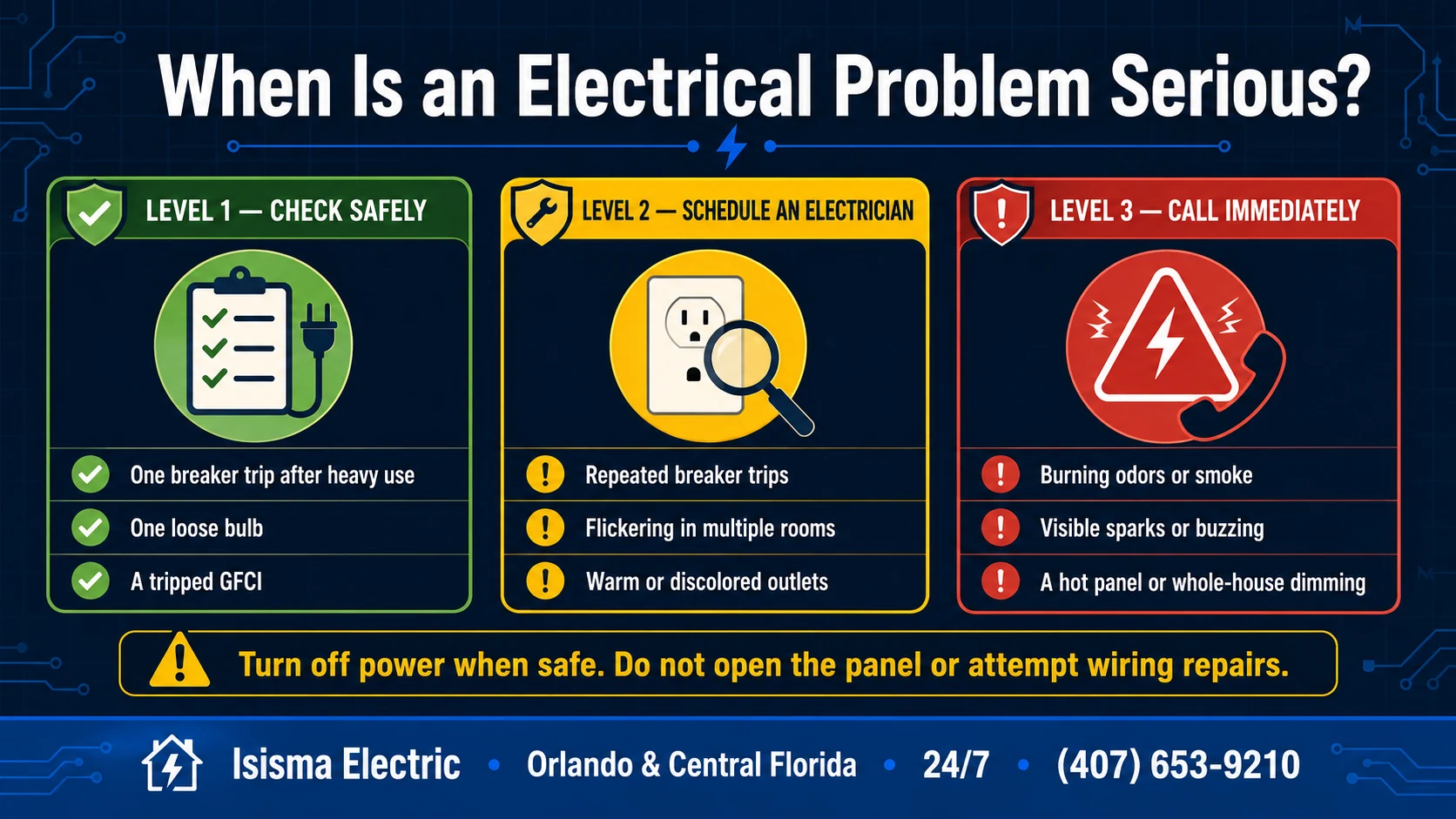
The seriousness of an electrical problem depends on repetition, heat, the number of affected circuits and whether there are signs of arcing or combustion.
A single breaker trip after using several high-draw appliances may point to a temporary overload. The same breaker tripping repeatedly with nothing connected indicates a problem that needs professional diagnosis.
Similarly, one loose bulb is usually a fixture-level issue. Flickering across multiple rooms, whole-house dimming, heat, sparks, buzzing, smoke or burning odors suggest a broader and potentially urgent electrical problem.
Why Central Florida homes see these problems more often
Homes in and around Orlando run air conditioning for most of the year, placing a steady load on circuits that may only experience that demand seasonally in cooler climates.
High humidity can accelerate corrosion inside outdoor outlets, garage panels and electrical equipment near pools, which is one reason connections in Florida properties may require closer attention.
Storm season adds another factor. Surges from lightning and the grid restoring service after an outage can place additional stress on wiring and panels already operating near their limits. Review Isisma Electric’s electrical service areas across Central Florida to confirm coverage at your address.
Tripped breakers
A breaker that trips is doing what it was designed to do: cutting power before a circuit carries more current than it can safely handle.
What usually causes it
Too many high-wattage devices running on one circuit, a short circuit inside an appliance, or a breaker that has become unreliable with age are common triggers.
What is safe to check
Unplug a few devices from the circuit and reset the breaker once. If it holds, the circuit may have been overloaded. If it trips again immediately, stop testing it yourself.
When to call an electrician
A breaker that trips with nothing plugged in, trips more than once within a short period, or comes from a panel that feels warm needs a licensed electrician rather than another reset.
Flickering or dimming lights
Occasional flickering when a large appliance starts can be caused by a brief increase in electrical demand. Flickering that happens frequently or in multiple rooms is more concerning.
What usually causes it
A loose bulb, aging switch contacts, or an overloaded circuit struggling when a heavy appliance draws power are common explanations.
What is safe to check
Tighten the bulb and confirm the fixture is rated for its wattage. If flickering continues, the problem may be in the wiring rather than the fixture.
When to call an electrician
Flickering across multiple rooms, whole-house dimming, or flickering combined with a warm switch points to an electrical issue that needs an inspection rather than another bulb.
Hot or discolored outlets and switches
An outlet or switch plate that feels warm or shows scorch marks may indicate that something behind the wall is generating heat.
What usually causes it
Loose wiring connections, internal resistance from a worn contact, or a circuit carrying more load than it was rated for are typical causes.
What is safe to check
Unplug anything connected to the outlet and avoid using it again. There is no safe way to diagnose heat behind a wall without opening and testing the circuit.
When to call an electrician
Any unexplained warmth or discoloration, with or without something plugged in, should be treated as a potential hazard and inspected promptly.
Buzzing or crackling sounds
Electricity moving through a sound connection should be silent. Buzzing or crackling can indicate that current is arcing or making intermittent contact.
What usually causes it
Loose terminal screws, a worn switch or outlet, or exposed wiring making intermittent contact are possible sources.
What is safe to check
Turn off power to the affected outlet or fixture at the breaker when it is safe to do so, and stop using it. This is not a repair to attempt without training.
When to call an electrician
Buzzing, crackling, sparks, smoke or burning odors require prompt professional attention. Isisma Electric provides 24/7 emergency electrical service in Orlando for urgent situations.
Outdated wiring in older homes
Older homes may have wiring and electrical panels that were not designed for today’s combination of air conditioning, electronics and high-draw kitchen appliances.
Aluminum wiring and ungrounded two-prong systems are examples of older configurations that may require professional evaluation. Aluminum connections can expand and contract during heating cycles, which may contribute to connections loosening over time.
An electrician can identify the type and condition of the wiring and recommend whether the property needs targeted corrections, approved connectors or more extensive replacement.
Environmental stress from Florida humidity and moisture
Moisture is an underestimated contributor to electrical problems in homes located in humid climates such as Central Florida.
Outdoor GFCI outlets, garage panels and components near pools experience more humidity and temperature cycling than interior equipment, which can accelerate corrosion.
A GFCI that trips repeatedly near a pool, garage or exterior wall may involve moisture, damaged equipment or another circuit condition. A professional should confirm the cause before the device is returned to regular use.
When the problem affects the whole house
Some electrical problems do not stay contained to one outlet or room. Lights dimming across the entire house, or several circuits behaving abnormally at once, can point toward the main panel, service equipment or utility supply rather than a single fixture.
Whole-house symptoms are difficult to diagnose without proper testing equipment. If multiple rooms or circuits are affected at the same time, treat the problem as a system-level concern rather than trying to isolate it outlet by outlet.
Isisma Electric offers coordinated electrical services for residential, commercial and industrial properties throughout the Orlando area.
Signs that mean stop and call today
Some symptoms require same-day attention rather than the next available routine appointment:
- Any burning smell coming from an outlet, switch or panel
- Visible sparking from an outlet or breaker
- A panel that feels warm or hot to the touch
- Buzzing coming from inside a wall or fixture
- Smoke from any electrical source
- Lights dimming across the entire house at once
If it is safe to do so, stop using the affected circuit and turn off power. Do not open the panel or attempt wiring repairs yourself.
How Isisma Electric diagnoses electrical problems in Orlando homes
Isisma Electric has served residential, commercial and industrial properties across Central Florida since 2019, with a team available around the clock to diagnose the issues covered above.
A visit begins with identifying the underlying cause rather than only addressing the visible symptom, followed by a clear recommendation before work begins.
If any of these warning signs sound familiar, request a free estimate or call (407) 653-9210 for assistance.
Frequently asked questions
What are the most common electrical problems in homes?
The most common electrical problems in homes are tripped breakers, flickering lights, warm or discolored outlets, buzzing sounds and issues that affect multiple rooms or circuits at once.
Is it normal for a breaker to trip occasionally?
A single trip after connecting several high-draw appliances may indicate an overloaded circuit. A breaker that trips repeatedly or with nothing connected should be inspected.
Why do Florida homes experience electrical problems?
Frequent air-conditioning use places a sustained load on circuits, while humidity can accelerate corrosion in outdoor outlets, garages and electrical equipment near pools. Storm-related surges can add further stress.
When should I call an electrician instead of troubleshooting myself?
Call immediately for burning smells, smoke, sparking, a hot panel, persistent buzzing or symptoms affecting multiple rooms. A basic check may be appropriate for one loose bulb, one tripped GFCI or a single breaker trip after heavy use.
The bottom line on electrical problems in homes
Many electrical problems start small: a flicker, a warm switch or a breaker that trips once. The seriousness increases when the symptom repeats, produces heat or odor, or affects multiple circuits.
Left unresolved, warning signs can point to damaged wiring, overloaded equipment or increased fire risk, especially in Central Florida properties that run air conditioning for much of the year.
If any of these signs sound familiar in your home, contact Isisma Electric to diagnose the problem and determine the appropriate next step.