

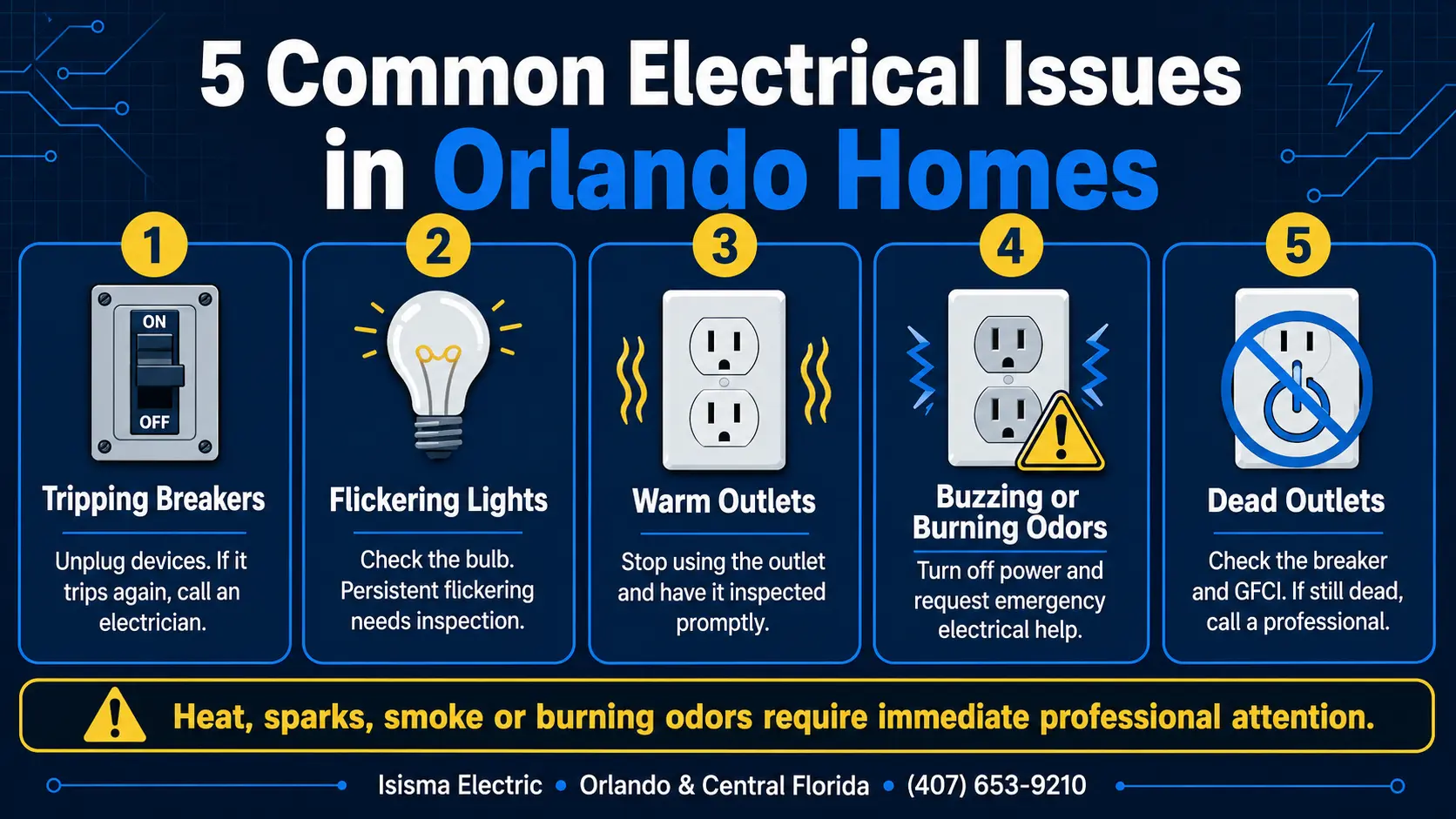
Common electrical issues include tripping breakers, flickering lights, warm outlets, buzzing sounds, and Common electrical issues include tripping breakers, flickering lights, warm outlets, buzzing sounds and dead outlets. Most of these point to loose connections, an overloaded circuit or wiring that is starting to age.
None of them should be ignored. A problem that looks small today, like a dimming light or a warm switch plate, is often the early stage of something that gets worse the longer it sits.
This guide breaks down the most common electrical issues homeowners encounter, what usually causes each one, what is safe to check yourself, and when the situation requires professional residential electrical service instead of a guess.
Quick answer for common electrical issues
The most common electrical issues in a home are tripping circuit breakers, flickering or dimming lights, warm outlets and switches, buzzing sounds or burning smells, and outlets that stop working.
These issues usually trace back to three root causes: a circuit carrying more load than it was designed for, a loose or corroded connection somewhere in the system, or wiring that has simply aged past its safe working life.
Any sign of heat, sparking or a burning smell is a safety issue, not a maintenance item, and may require an emergency electrician in Orlando the same day.
Why do these issues show up more in Central Florida homes?
Orlando homes deal with conditions that push electrical systems harder than in milder climates. Long, humid summers mean air-conditioning units run for most of the day, adding constant strain to circuits and panels.
Humidity also speeds up corrosion inside outlets, breaker panels and junction boxes, which is a common reason connections loosen years before they would elsewhere.
Storm season adds another layer. Power surges from lightning strikes or the grid restoring service after an outage can stress wiring that was already close to its limit.
Homes built before the 1990s in Central Florida may also have aluminum wiring or panels that were never sized for today’s appliance and AC loads. Homeowners can review Isisma Electric’s Central Florida service areas to confirm coverage at their property.
1. Tripping circuit breakers
A breaker that trips is doing its job. It is cutting power because a circuit tried to draw more current than it can safely carry.
What usually causes it
A single outlet powering several high-draw appliances, a short circuit inside a device, or a breaker that has aged and become overly sensitive are the three most common triggers.
What you can check safely
Unplug a few devices from that circuit and reset the breaker once. If it holds, the circuit may have been overloaded. If it trips again with nothing plugged in, stop testing it yourself.
When to call an electrician
If the same breaker trips repeatedly within a day, trips with nothing connected or the panel feels warm, this is a job for a licensed electrician rather than another reset.
2. Flickering or dimming lights
Occasional flickering when a large appliance starts may be caused by a brief increase in electrical demand. Lights that flicker frequently or across multiple rooms are a different concern.
What usually causes it
Loose bulbs or fixture connections, aging wiring connections behind the wall, or a large appliance such as an AC compressor pulling a sudden surge of current are typical causes.
What you can check safely
Tighten the bulb and confirm that the fixture is rated for its wattage. If flickering continues, the cause may be inside the wiring rather than the fixture.
When to call an electrician
Persistent flickering across multiple rooms, especially when paired with a burning smell, can indicate a wiring problem that needs professional evaluation.
3. Warm outlets or switches
An outlet or switch plate that feels warm to the touch may indicate that something behind the wall is not operating correctly.
What usually causes it
Loose wiring connections, resistance heating from a worn connection, or a circuit carrying more load than it was rated for are the most common reasons.
What you can check safely
Unplug anything connected to the outlet immediately and avoid using it. There is no safe way to diagnose heat behind a wall without opening and testing the circuit.
When to call an electrician
Any unexplained warmth in an outlet or switch, with or without something plugged in, should be treated as a potential hazard and inspected promptly.
4. Buzzing sounds or burning odors
Electricity moving through a healthy connection should be silent. A buzzing sound or burning smell can mean that current is arcing or a component is overheating.
What usually causes it
Loose or exposed wiring, an overheated switch, or melting plastic inside an outlet or electrical device are likely sources.
What you can check safely
Turn off power to the affected outlet or fixture at the breaker and stop using it. This is not an appropriate DIY repair.
When to call an electrician
Buzzing or burning smells qualify as an emergency call rather than a regular appointment. Isisma Electric provides 24/7 electrical assistance throughout Orlando and surrounding Central Florida communities.
5. Dead outlets
An outlet that suddenly stops working is rarely random. It usually points to a specific problem affecting the circuit protecting it.
What usually causes it
A tripped breaker, a broken wire connection somewhere along the circuit, or a tripped upstream GFCI outlet are the three most common explanations.
What you can check safely
Check the breaker panel first, then look for a nearby GFCI outlet with a reset button. One tripped GFCI can interrupt power to several outlets farther down the circuit.
When to call an electrician
If resetting the breaker and GFCI does not restore power, a connection may have failed and require professional electrical repair.
Electrical issues that need more than a quick fix
Some electrical problems stay hidden behind walls and only surface during an inspection, renovation or home sale. These are worth knowing about even if you never see an obvious symptom.
Panels with double-tapped breakers—two wires forced onto a terminal designed for one—are a potential safety concern sometimes found in older homes.
Outlets that appear grounded but are not, incorrectly wired subpanels, and GFCI protection that has stopped working are additional problems that may look normal from the outside.
These conditions demonstrate why periodic evaluation by a qualified provider of electrical services in Orlando matters, even when nothing seems wrong.
Signs it is time for an emergency call
Some symptoms mean you should stop using the affected circuit and call immediately rather than adding the problem to a future to-do list:
- Any burning smell coming from an outlet, switch or panel
- Visible sparking from an outlet or breaker
- A breaker panel that feels warm or hot
- Buzzing coming from inside a wall or fixture
- Smoke, even briefly, from any electrical source
Isisma Electric provides 24/7 emergency electrical service across Orlando and Central Florida for these situations.
How Isisma Electric handles common electrical issues in Orlando
Isisma Electric has served residential, commercial and industrial properties across Central Florida since 2019, with a team available around the clock for the electrical issues covered above.
Every call starts with a straightforward diagnosis, a clear explanation of what may be causing the problem and a recommendation before work begins.
If you are seeing any of these warning signs in your Orlando home, request an electrical service estimate or call (407) 653-9210 for assistance.
Common electrical issues FAQs
What are the most common electrical issues in a home?
The most common electrical issues are tripping breakers, flickering lights, warm outlets, buzzing sounds and outlets that stop working. These problems are commonly associated with circuit overloads, loose connections or aging wiring.
Is it normal for a breaker to trip once in a while?
An occasional trip after connecting a high-draw appliance may indicate an overloaded circuit. A breaker that trips repeatedly or with nothing connected is not normal and should be checked.
Can I fix a warm outlet myself?
No. A warm outlet should be unplugged and left unused until a licensed electrician inspects the wiring behind it, since the cause is not visible from outside the wall.
How often should Orlando homes get an electrical inspection?
Homes over 15 years old, or homes with a history of flickering, repeated breaker trips or warm outlets, may benefit from an inspection every few years. The appropriate frequency depends on the age and condition of the electrical system.
The bottom line on common electrical issues
Most common electrical issues start small: a flicker, a warm switch or a breaker that trips once. Caught early, they may be easier and less expensive to correct.
Left unresolved, the same warning signs can point to wiring damage, overloaded panels or increased fire risk, especially in Central Florida homes that run air conditioning during much of the year.
If any of these signs sound familiar, contact Isisma Electric for help diagnosing the issue and determining the appropriate next step for your property.